
Case Study
ROI of Electric Farm Carts: How Many Harvests Until Payback?
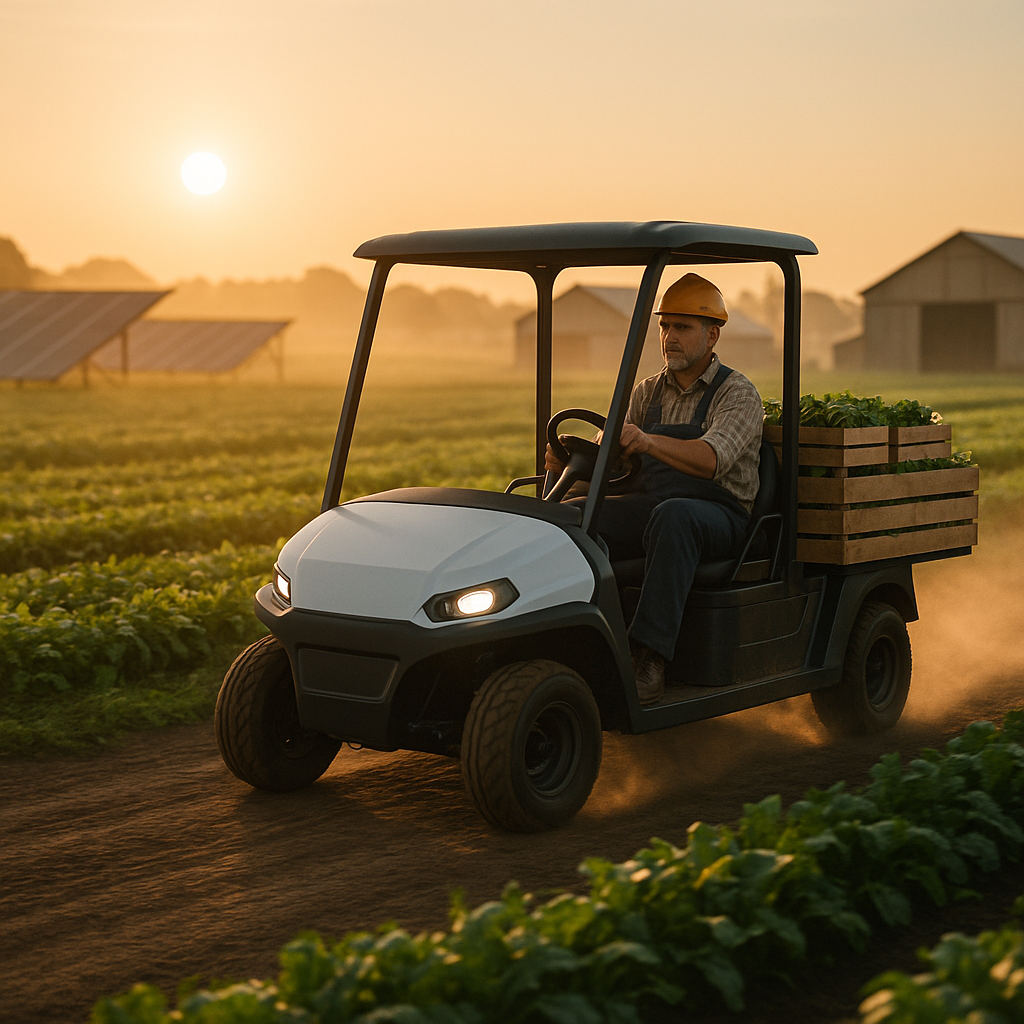
The Payback Power of Electric Farm Carts
I’ve seen farmers push carts and haul crates by hand long after the return on that labor stopped making sense. It’s not stubbornness — it’s habit. But today, habits are expensive. Fuel costs are rising, labor is harder to find, and time between harvests feels shorter every year.
That’s where electric farm carts come in. They’re not gadgets or gimmicks. They’re quiet, reliable workhorses that replace wasted motion with measurable output. When I run the numbers, most farms see their farm cart ROI in under two years — often within just two harvests. That’s faster than nearly any other mechanization investment on the field.
Thinking in Spreadsheets: What ROI Really Means
When I talk about farm cart ROI, I’m not talking theory — I’m talking math.
A mid-range electric cart costs $8,000–$15,000, while entry-level diesel units might run cheaper up front. But the electric cart wins on total cost of ownership. No fuel, minimal maintenance, and fewer breakdowns.
When you break it down:
- Labor savings alone often recover 30% of costs in the first year.
- Maintenance and fuel reductions handle the rest.
- Most farms break even within 18–24 months, depending on usage.
In my experience, a good rule of thumb is this:
“A good cart pays back in seasons, not years.”
A Case from the Field
Last year, I worked with a rice farm cooperative that switched from manual wheelbarrows to three electric farm carts. Before the change, ten workers spent full days hauling sacks between the field and the dryer — slow, exhausting, and inconsistent.
After adoption:
- Labor demand dropped by 30%
- Hauling time dropped by 25%
- Fuel and maintenance costs fell by 40% compared to diesel carts
- Payback came in under 20 months
When I asked the farm owner what he noticed most, he didn’t say “speed.” He said, “Consistency. My team finishes before sunset now.” That’s the kind of ROI you can feel.
ROI Benchmarks: Where Electric Carts Stand
Let’s put the numbers in context. Here’s how electric carts compare to other farm tools when you measure pure payback period.
| Equipment Type | Typical Cost | Avg. Payback Period | Key ROI Driver |
|---|---|---|---|
| Manual wheelbarrow | <$500 | — | Labor intensive |
| Small diesel cart | $3K–$6K | 3–5 years | Fuel & maintenance |
| Electric farm cart | $8K–$15K | 18–24 months | Labor & fuel savings |
| Compact tractor | $25K+ | 5–7 years | Versatility, higher overhead |
The takeaway? Electric carts hit the sweet spot — affordable, efficient, and just modern enough to change the equation. They’re the ROI benchmark for practical mechanization.
Labor Efficiency Is Profit, Not Overhead
People often forget that efficiency isn’t just about machines — it’s about people. Every unnecessary lift, every wasted step, every strain injury is lost profit.
Electric carts eliminate most of that waste. They:
- Cut repetitive lifting (which means fewer back injuries)
- Keep workers fresh through long harvest days
- Reduce idle time — the hidden enemy of productivity
I like to say, “The safest process is the most profitable process.” When your crew works smarter, not harder, your ROI multiplies naturally.
How to Calculate Your Payback Period
If you want to know how soon you’ll recover your investment, use this simple ROI equation: Payback (months)=Cart CostMonthly Savings (Labor + Fuel + Time)\text{Payback (months)} = \frac{\text{Cart Cost}}{\text{Monthly Savings (Labor + Fuel + Time)}}Payback (months)=Monthly Savings (Labor + Fuel + Time)Cart Cost
Example:
- Cart Cost = $10,000
- Monthly Savings = $500
- Payback = 20 months
Every operation’s math will differ, but the principle holds: the more you move, the faster you pay it off. Farms that use their carts daily often see profit by the third harvest.
Bottom Line: Mechanization That Pays for Itself
You can’t scale yield with muscle power alone.
Mechanization isn’t about replacing people — it’s about protecting them and making every hour count. Electric farm carts prove that modernization can be both humane and profitable.
So if you’re still asking whether they’re worth it, run the numbers yourself.
You’ll see what I’ve seen across dozens of farms:
A good cart pays for itself — and then starts paying you back.