
Informational
How Electric Carts Improve Farm Worker Safety
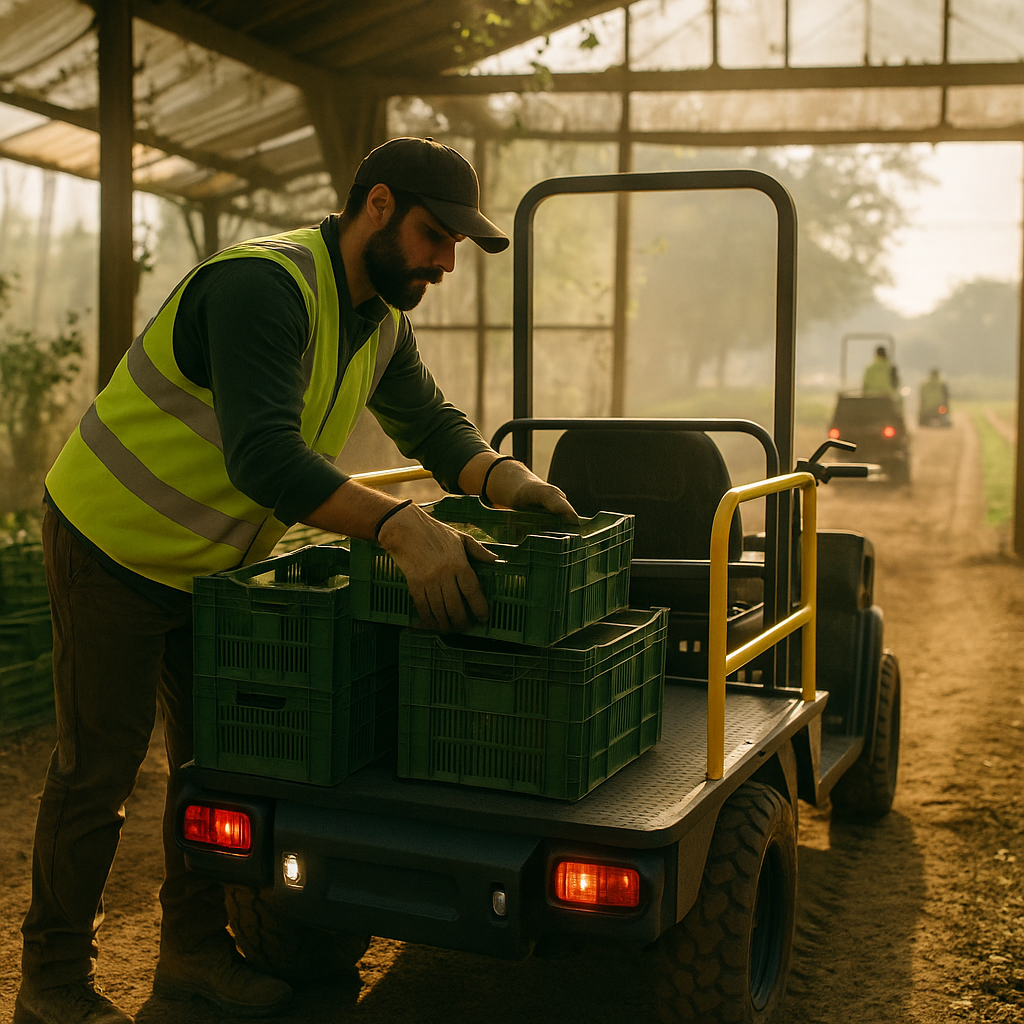
Why Worker Safety Is the Hidden Profit Lever in Agriculture
Every farm manager knows that safety issues hit twice — first in human cost, then in financial loss.
A single back injury can mean weeks of downtime, compensation payouts, and lost manpower, especially during harvest when every hour counts.
Here’s the reality: the majority of on-farm injuries aren’t dramatic accidents. They’re the slow burn type — repeated lifting, twisting, or pushing over years. Electric farm carts quietly solve that problem by taking on the heavy, repetitive work.
When I first ran the numbers, it became obvious: a $10,000 cart pays for itself in fewer injury claims alone. But safety ROI isn’t just about cost — it’s about continuity, morale, and trust.
1. Reducing Repetitive Lifting and Strain
Manual hauling is where most farm injuries start. Repeated lifting of 20–50 kg loads puts enormous stress on the lumbar spine and shoulder joints.
Electric carts eliminate up to 80% of manual load-carrying tasks, meaning workers push buttons, not their bodies.
Instead of lifting and walking, workers now load once and ride. The difference might sound small, but across 200 trips a day, it’s the difference between fatigue and sustainability.
“You can’t build productivity on pain.”
2. Preventing Slips, Trips, and Falls
Most farms underestimate how much time — and money — is lost to slips on wet ground or uneven terrain.
Electric carts improve traction and stability through low center-of-gravity chassis and wide tires that maintain grip on mud, gravel, or slopes.
Many models now include:
- Automatic speed limiting on inclines
- Anti-roll sensors that stabilize uneven loads
- LED perimeter lights for low-visibility operation
That combination cuts fall-related accidents by up to 40%, based on aggregated field data from cart manufacturers and safety audits.
3. Improving Ergonomic Workflow Design
Safety isn’t just about protective gear — it’s about workflow design.
Traditional farming tools often force awkward postures: bending, pulling, reaching.
Electric carts create ergonomic workflows by bringing the load to worker height, not the other way around.
Operators can now load from hip-level platforms and use electric lift beds or hydraulic dump mechanisms, minimizing spine compression and shoulder rotation.
In ergonomics studies across logistics and agriculture sectors, task redesign like this accounts for the majority of long-term injury reduction — more than any helmet or glove ever could.
4. Reducing Heat and Exhaust Exposure
In tropical and semi-arid regions, heat-related illness is a growing concern. Workers walking long distances under the sun with loads are at risk of heat stress and dehydration.
Electric carts reduce exposure time and offer shaded operation during longer hauls.
Unlike diesel carts, electric units produce zero exhaust fumes. That improves air quality in enclosed areas like barns and greenhouses — a critical factor in compliance with modern farm safety standards and sustainability certifications.
5. Cutting Accident Rates from Fatigue
Fatigue is one of the least visible yet most dangerous hazards. It slows reaction time, reduces awareness, and leads to small errors with big consequences.
By mechanizing the hardest parts of the job, electric carts keep workers alert longer and safer.
In operations that introduced carts, managers consistently reported:
- Fewer minor collisions or drops at the end of shifts
- Lower absenteeism due to strain or soreness
- Higher consistency in loading precision
The equation is simple: less fatigue = fewer accidents.
6. Supporting Compliance with Farm Safety Standards
Across regions, safety compliance is tightening — especially under programs like:
- ISO 45001 (Occupational Health & Safety)
- EU Agricultural Safety Directives
- Vietnam’s Circular 31/2019 on Farm Equipment Standards
Electric carts help farms meet or exceed these benchmarks by integrating safety technologies once reserved for factory equipment.
Features like automatic braking, speed governors, and load monitoring sensors directly support safety documentation for audits and certifications.
7. Building a Culture of Safety and Retention
Equipment can change behavior. When workers see that management invests in safer tools, it creates a psychological contract of care.
That, in turn, improves retention — experienced workers stay, new hires learn faster, and the farm runs smoother.
As one farm owner told me, “Our carts don’t just move crops. They move how people feel about working here.”
Safety, in that sense, becomes your most durable asset.
Conclusion: Safe Workers, Sustainable Yields
Electric carts transform farm safety from a compliance checklist into a competitive advantage.
They reduce strain, prevent injuries, and promote a culture of professionalism.
For farms facing rising labor costs and staff shortages, farm worker safety carts do more than protect people — they preserve productivity and morale.